
This is probably one of the biggest areas of frustration and confusion for people suffering hives, because in many cases the cause of hives is unknown. It may be useful to think about it in two ways: what causes the disease in the first place and what triggers an outbreak.
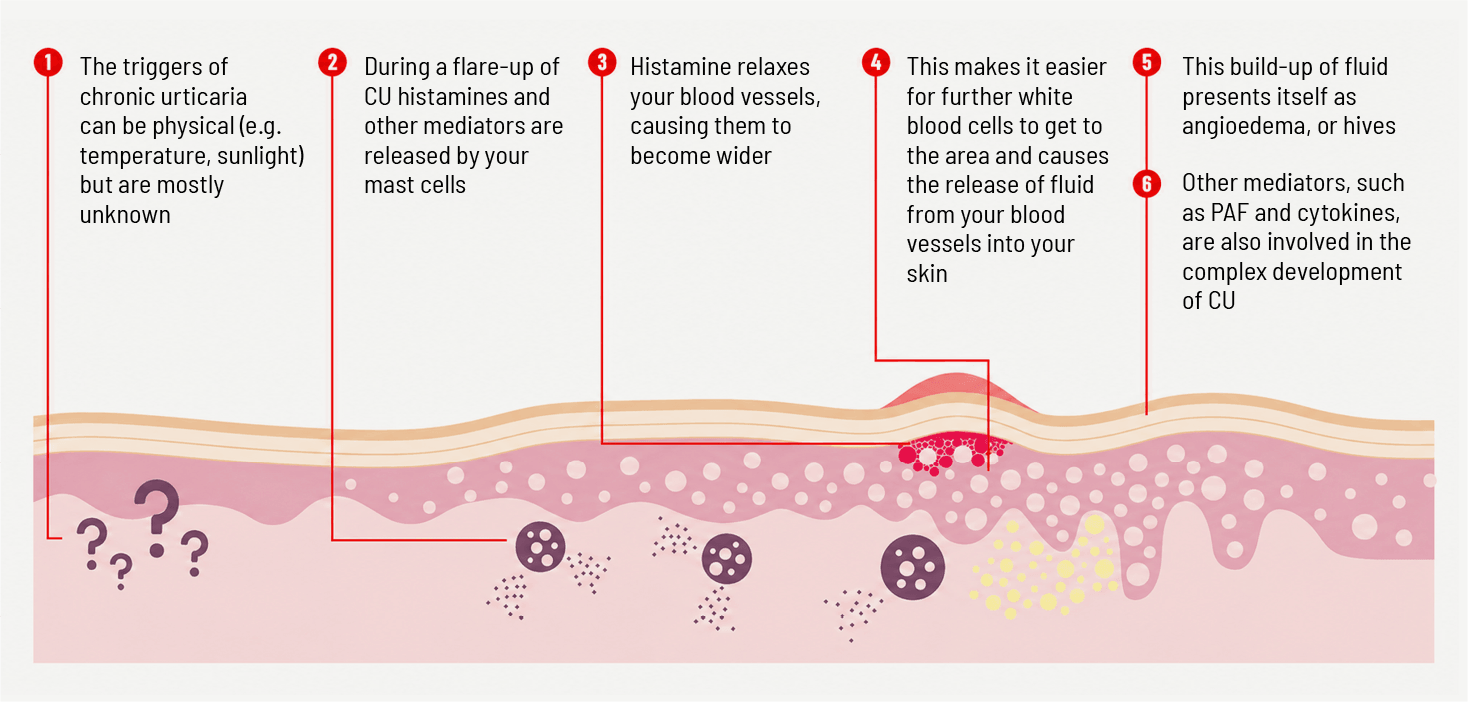
All forms of hives involve the immune system and, specifically, mast cells. Mast cells are an important part of the immune system and occur in areas of the body that encounter your surroundings – e.g. in skin and mucous membranes. They recognise threats such as foreign bacteria or parasites and become activated to release histamines and other chemicals. These chemicals send messages to other parts of the immune system so that a response can be mounted to fight any foreign invaders.1
Chronic spontaneous urticaria (CSU) is often thought of as a skin condition, but it actually involves specialized immune cells all throughout the body, not just the skin. That's why it's considered a systemic disease.
These specialized immune cells, called mast cells, play a key role in CSU.2 These cells are part of your body's normal defense system and are found in many tissues throughout the body, including the skin. When activated, mast cells release a substance called histamine into these nearby tissues - this causes the visible symptoms of urticaria, like redness, itching, or swelling.3
In CSU, mast cells get activated when the immune system mistakenly reacts to harmless substances, or even to the body's own tissues. This overreaction triggers mast cells to release histamine when they shouldn't. In about half of CSU cases, this process is autoimmune, meaning the body reacts against itself.
Since mast cells are so concentrated in the skin, urticaria symptoms like itching, redness, and swelling are most noticeable there.3 However, mast cells are also found in other areas of the body, such as the intestinal lining, which explains why symptoms can sometimes affect more than just the skin.
Unlike CSU, chronic inducible urticaria (ClndU) occurs in response to specific factors such as heat, cold, sunlight, pressure, exercise, stress, certain substances, or friction from clothing. Some people with ClndU react to one clear factor, while others may notice several. ClndU can also occur alongside CSU. Observing patterns in symptoms, such as links to certain factors or situations, can provide information useful for a medical consultation.
The causes of acute hives are usually viruses, allergies or insect stings.4
You deserve more - don’t let CSU control your life. Ask your doctors about clear skin and zero itch.
Symptom checkerExplore on this site
Chronic urticaria causes – what are they? What causes itchy hives?References
- Urb M and Sheppard DC. PLoS Pathog 2012; 8:e1002619.
- Friedman A, et al. Dermatol Ther (Heidelb).Adis. 2024;14(6):1371-87.
- Metcalfe DD, et al. Physiol Rev. 1997;77(4).
- Fine LM and Bernstein JA. Allergy Asthma Immunol Res 2016; 8:396-403.