
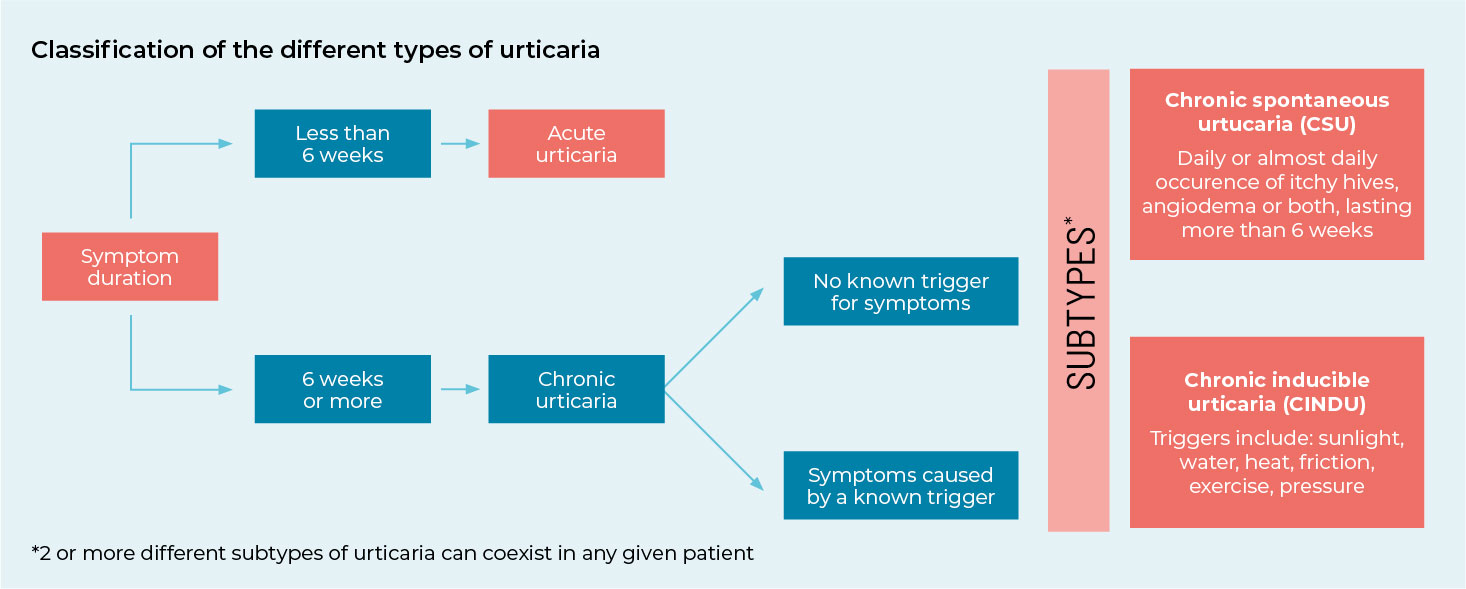
Hives can be acute or chronic. Chronic hives are further divided into chronic spontaneous urticaria (CSU) and chronic inducible urticaria (ClndU).1
This is the most common form of hives. Symptoms like redness, itching, swelling, or raised bumps appear suddenly and typically last from a few hours up to six weeks.2 Because outbreaks often resolve quickly, people don't always seek medical advice.
In many cases, the exact cause cannot be identified but possible origins include:
Pseudoallergic reactions to medications, even those previously well tolerated
Infections in the ear, nose, throat, teeth, or gastrointestinal tract Allergies caused by pollen or food.
If your symptoms last for more than six weeks, it's known as chronic urticaria. Hives, itching, and swelling may appear daily, weekly, or at random intervals over a longer period. Chronic urticaria is divided into two main types, depending on whether a trigger can be identified:
When hives last for more than six weeks without an identifiable external cause, it's called chronic spontaneous urticaria (CSU). "Spontaneous" means that symptoms appear unpredictably without a known cause. CSU is also not an allergy.3
CSU can last for months or even years and can have a serious emotional and physical impact, affecting sleep, work, and daily life.2 The condition can go away on its own over time, though it is impossible to predict when.4
Around two-thirds of people with chronic urticaria have this spontaneous form.5 In these cases, symptoms are caused by an overactive immune system reacting to harmless substances in the body rather than to anything external.
Unlike CSU, chronic inducible urticaria (ClndU) occurs in response to specific factors such as heat, cold, sunlight, pressure, exercise, stress, certain substances, or friction from clothing. Some people with ClndU react to one clear factor, while others may notice several. ClndU can also occur alongside CSU. Observing patterns in symptoms, such as links to certain factors or situations, can provide information useful for a medical consultation.
Information about the different types of hives and symptom patterns may support discussions during medical consultations. The Hive Guide outlines ways to structure discussions about symptoms that may occur during conversations with your doctor.
DownloadDo you know that not all hives are allergy related? Take the test to see how hives is impacting your life.
Symptom checkerExplore on this site
The different types of hives (urticaria)
Locate a specialist
Australasian Society of Clinical Immunology and Allergy (ASCIA)Australasian College of Dermatologists
References
- Australasian Society of Clinical Immunology and Allergy. ASCIA HP Position Paper Chronic Spontaneous Urticaria Guidelines 2020. Available from https://allergy.org.au/images/stories/pospapers/ASCIA_HP_Position_Paper_CSU_2020.pdf Accessed May 2026.
- Zuberbier T, et al. The international EAACI/GA2LEN/EuroGuiDerm/APAAACI guideline for the definition, classification, diagnosis, and management of urticaria. Allergy: Eur J Allergy Clin Immunol 2022;77(3):734-66.
- Powell RJ, et al. Clin Exp Allergy 2015;45(3):547-65.
- Balp MM, et al. Dermatol Ther 2022;12(1):15-27.
- Bizjak M, Kosnik M. Front Allergy 2024;5.