
Failure to identify the cause of chronic hives can be very frustrating. What is clear is that allergy is not one of the chronic urticaria causes.1
Hives are the result of mast cells being activated by your immune system to release histamines and other chemicals into the affected area, which in turn results in red, itchy, swollen skin.2 Mast cells occur in parts of the body that are exposed to our surroundings – e.g. in skin and mucous membranes. They recognise threats such as foreign bacteria or parasites which activates them to release histamines and other chemicals.3 This is a normal surveillance system, but in urticaria the mast cells are activated without any external threat.
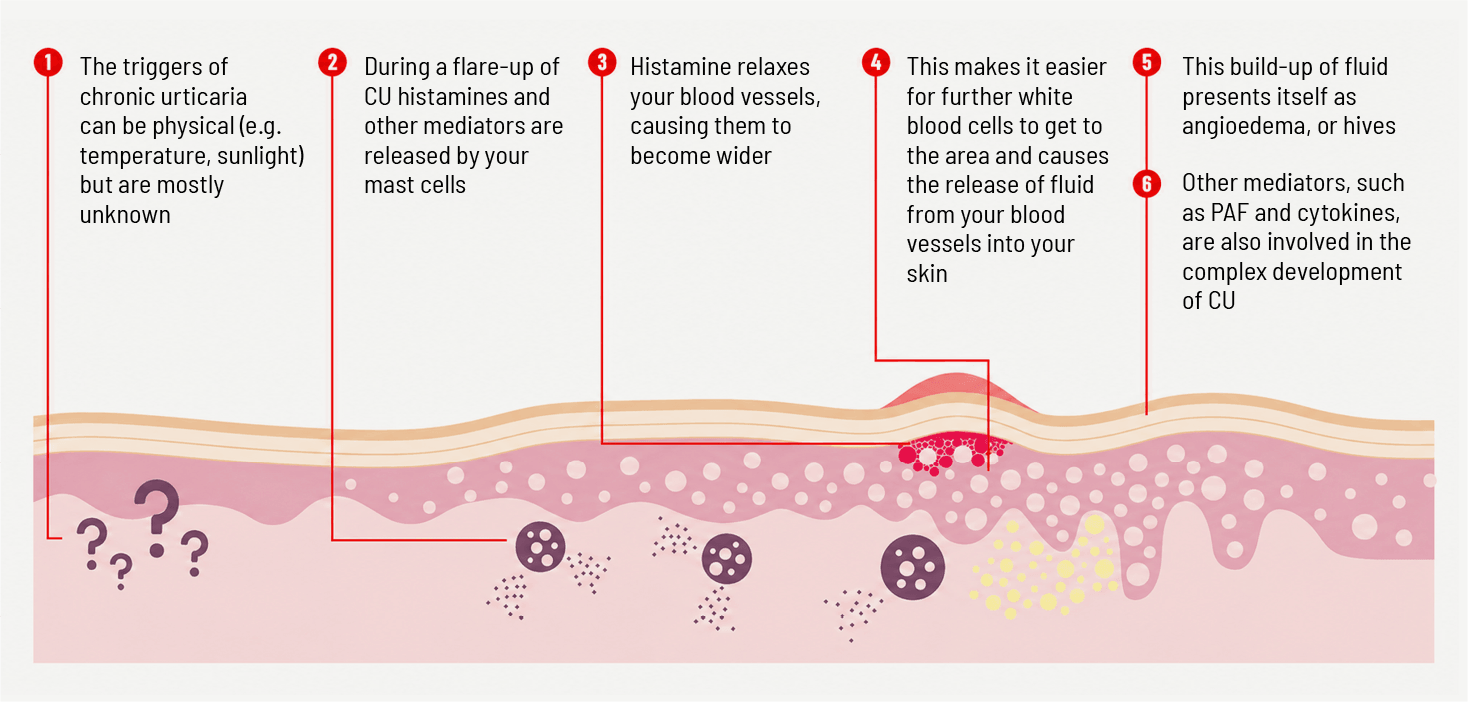
Chronic urticaria triggers
Some forms of chronic hives have known physical triggers, but most do not.
- Unlike CSU, chronic inducible urticaria (ClndU) occurs in response to specific factors such as heat, cold, sunlight, pressure, exercise, stress, certain substances, or friction from clothing. Some people with ClndU react to one clear factor, while others may notice several. ClndU can also occur alongside CSU. Observing patterns in symptoms, such as links to certain factors or situations, can provide information useful for a medical consultation.
- In chronic spontaneous urticaria there is no identifiable external trigger, which makes it impossible to predict when an outbreak will occur.
Chronic spontaneous urticaria causes
There are several causes of chronic spontaneous urticaria:
- Autoantibodies – approximately 50% of people with chronic spontaneous urticaria have an autoantibody, which is an antibody that attaches to mast cells and other immune cells to activate them even when there is no threat4
- Autoallergies – this is where a specific allergy antibody recognises one of your proteins (e.g. a thyroid protein) which activates the mast cells4
- Autoimmune disorder – there is a strong association between chronic spontaneous urticaria and other autoimmune disorders.1
- Underlying infections – certain bacterial infections have been linked to people with chronic spontaneous urticaria5
Information about the different types of hives and symptom patterns may support discussions during medical consultations. The Hive Guide outlines ways to structure discussions about symptoms that may occur during conversations with your doctor.
DownloadNot all hives are allergy related. Take the test to see how hives are impacting your life.
Symptom checker
Explore on this site
What causes hives? What causes itchy hives?References
- Australasian Society of Clinical Immunology and Allergy. ASCIA HP Position Paper Chronic Spontaneous Urticaria Guidelines 2020. Available from https://allergy.org.au/images/stories/pospapers/ASCIA_HP_Position_Paper_CSU_2020.pdf Accessed May 2026.
- Australasian Society of Clinical Immunology and Allergy. ASCIA PC Hives Urticaria 2024. Available from https://allergy.org.au/patients/skin-allergy/urticaria-hives Accessed May 2026.
- Urb M and Sheppard DC. PLoS Pathog 2012; 8:e1002619.
- Asero R et al. F1000Research 2017; 6:1095.
- Bernstein JA et al. J Allergy Clin Immunol 2014; 133:1270-1277.